
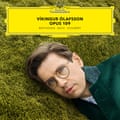
Despite the common practice of considering Beethoven’s last three piano sonatas as a collective unit, Víkingur Ólafsson has chosen to spotlight Sonata no. 30 in E major, Op. 109. he situates this composition within a wider musical framework that includes both the earlier works of the composer and the cultural milieu of early 19th-century Vienna.
A Retrospective Lens on Beethoven’s Work
Ólafsson employs a reflective approach by invoking Bach, whose impact he identifies throughout Beethoven’s later compositions. He argues that Beethoven’s uninhibited creativity is profoundly influenced by Baroque traditions, marked by elements of improvisation and an energetic dance-like quality.
The Musical journey Begins wiht Bach
The album opens with Bach’s Prelude in E major from the Well-Tempered Clavier, Book I; interestingly, all pieces included are either in E major or E minor—keys that evoke various shades of green for Ólafsson due to his synesthetic experiences. The music unfolds with an elegant detachment reminiscent of Baroque style before smoothly transitioning into a lucid interpretation of Beethoven’s Piano Sonata No.27 in E minor, Op.90—a work Ólafsson considers a direct precursor to opus109.
A Refreshing Interlude Before Diving Deeper
A clear rendition of bach’s final partita acts as an excellent palate cleanser prior to exploring Schubert’s lesser-known Piano Sonata No.6 in E minor—a piece that appears influenced by Beethoven’s Opus90 when viewed through this lens.The transition into the eagerly awaited Opus109 is nothing short of stunning; not only does Ólafsson demonstrate remarkable expressive diversity here, but it also emerges as one of the most beautifully rendered interpretations ever recorded.
An Invitation to Explore New Horizons
While purists may find certain elements challenging, those willing to embark on this journey will uncover an expansive vista leading toward an extraordinary new realm.